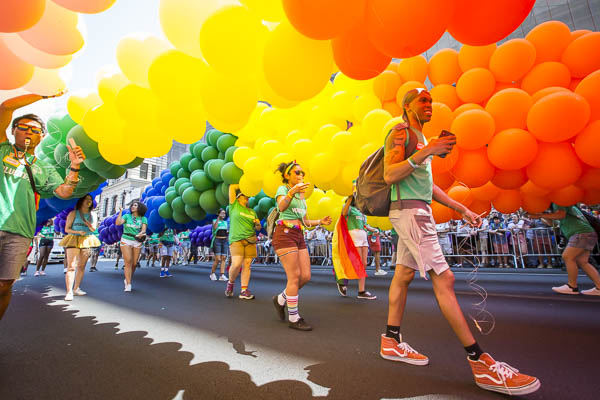
BY WINNIE McCROY | Nationwide throughout June, Pride celebrations were
scaled back due to corporate sponsors withdrawing financial support in reaction
to the unabashedly anti-LGBTQ+ Trump administration. New York City Pride is
facing a shortfall from these fair-weather friends; organizer Heritage of Pride
(HOP) has worked to fill the gap with grassroots fundraising and support from
local businesses.
But other NYC Pride events, like the NYC Dyke March and Reclaim Pride
Coalition’s Queer Liberation March, have gone forward relatively unchanged
—because they have never relied on corporate largesse. Elsewhere, some folks
are taking care of themselves. In Minnesota, after Minneapolis/Saint Paul’s
Twin Cities Pride dropped Target and its $50,000 contribution as a reaction to
the retailer retreating from DEI (diversity, equity, inclusion) initiatives, the
public ponied up $113,000 to keep the event going.
Hope at HOP
According to The New York Times, HOP operated at a loss of more than $2.7M
in 2022 and $1.2M in 2023, on a budget of about $5.5M. Sadly, it’s a national
trend. Bloomberg reports that funding for San Francisco Pride is down about
$200,000 after Comcast, Anheuser-Busch, and others dropped support.
This year’s HOP programming has faced corporate drawbacks, leading to a
$750,000 gap in funding. HOP says that while a handful of large partners have
decreased their presence or pulled out altogether, they have seen new supporters
—especially small, local businesses—come forward.
“One lovely surprise is that Viiv Healthcare stepped up to sponsor a Wellness
Fest at the Pride Street Fair,” said Matt Cheng, Associate Director of Corporate
Partnerships for NYC Pride. “They are helping us uplift LGBTQA resources at
our street festival, and that is nice to see.”
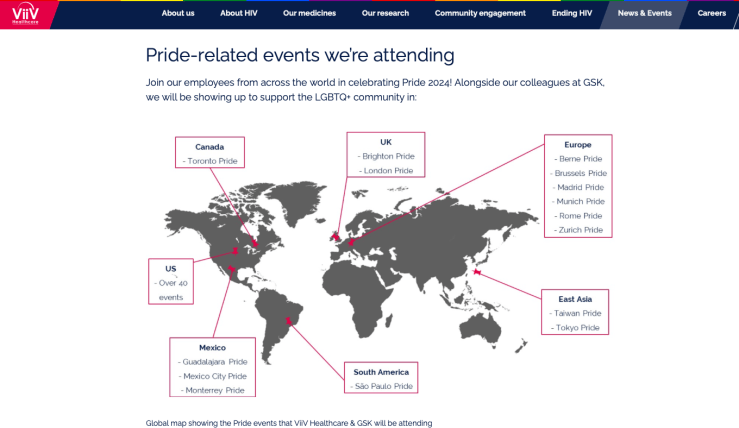
“Viiv Healthcare’s continued support is rooted in our shared goal of making a
difference in the lives of people impacted by HIV,” said Viiv Head of North
America Pearl Pugh, in a statement. Viiv has been the only pharmaceutical
company solely dedicated to pioneering HIV treatment and prevention
medication, and said they are investing in the future of youth leaders and
mentors, as the key to ending the HIV epidemic.
While the financial support may be lower, Cheng said the amount of people at
June 29’s NYC Pride March will be about the same. Shrinking corporate support
has led to community groups or smaller factions registering to march in their
stead. HOP expected 60 floats and 75,000 marchers—about the same as usual.
This year’s theme of Rise Up: Pride in Protest has also found an exponential
increase in the presence of small business support. While huge parties by global
liquor brands may be out, smaller local businesses like Brooklyn Brewery have
doubled their financial support and have donated their space for Road to Pride
fundraising events and parties.
Reclaim Pride Coalition organizer and co-founder Jay W. Walker said that what
happened to Heritage of Pride “was already happening to pride and queer
organizations across the country before the election. The New Fest lost a big
auto company sponsorship because of pressure put on the company by
Republican operatives. The handwriting was already on the wall, and it was not
surprising—probably not even to Heritage of Pride.”
“I had just heard that in Minneapolis, all the corporate sponsors were out,”
echoed NYC Dyke March organizer Maxine Wolfe in a May 2025 interview.
“They are going ahead with Pride anyway, which is good. My main objection to
corporate sponsors is that it was always about them, not about us.” Wolfe, a longtime NYC Dyke March organizer and Lesbian Herstory Archives coordinator, said while she had mixed feelings about the New York Pride March, it served as a place for people to be out and proud, and she would not engage in horizontal hostility within our gay community.
“But we’re not home-free yet; we still have to fight for what we want and how we
want to be treated,” Wolfe added. “Like with the transgender issues going on
now—they will always come for the weakest part of our community. It will
always be a battle, until we get rid of people making their careers on our backs.”
And WorldPride, held this year in Washington, DC, (May 17-June 8) offered a
scaled-down celebration to its estimated 2M visitors after federal contractor Booz Allen Hamilton withdrew sponsorship over DEI concerns. Comcast, Darcars Automotive Group, and Deloitte followed.
Who’s in Retreat and Who’s at the Forefront?
“This is a terrible year, probably the worst Pride I can remember in 45 years,” said Todd Evans, President and CEO of Rivendell, America’s oldest and most established LGBTQ media firm, representing 95 percent of all LGBTQ and HIV publications—more than 200.
“It’s twofold, because there’s not just the Trump administration’s attack on
anything LGBTQ+, but there’s also the debacle of what we’re calling the
Anheuser-Busch controversy, where more than $300,000 of Pride ads were
canceled within a few days,” said Evans.
That said, Evans still can’t even mention those sponsors that have given support
under the caveat of an NDA (non-disclosure agreement). He points to the ‘90s
when Miller Beer promoted the March on Washington and saw a gay rush on
their beer. Miller were great advertisers for the gay press over the next decade—
yet during that time, still asked Evans not to mention their name when quoted in the mainstream press.
“It’s always been that way,” said Evans. “But 75 percent of Americans are looking
for companies to step up for the American values of diversity and equity. I think
whoever does will reap rewards like no other—like Absolut, which stayed true
even through the AIDS crisis. That’s how they got that position at the top of the
LGBT-friendly list.”
These days, big ad agencies are swapping multicultural marketing for “growth
and market segmentation,” says Evans. The message has gotten through that
every niche community has individual purchasing economics and expects some
reciprocity for their dollar. “Because,” asks Evans, “how exactly are you helping
our community if you are giving us $100,000, but making millions off us?”
Evans points to Target as a prime example of this. In 2019, Target “did
everything right,” from the universal bathrooms in stores to carrying Pride gear.
Turning away from that was “a failure of leadership that starts at the top and
trickles down,” said Evans—one that will come back to haunt them.
Evans acknowledged that he “gets being afraid of a Trump Tweet, but when that
tide turns it will turn fast, and be a complete about-face. The world is going to
change, but I don’t think people will forget who was there for us, who came to
the forefront.”
People’s Pride Perseveres
Everything old is new again, as they say—especially when it comes to how this
year’s Pride celebrations will look. In New York City specifically, that means that
the protest model of yore, featuring unpermitted and unsponsored celebrations,
is paramount.
After miserable experiences at past HOP Marches—and seeing an ever-wider
swath of both older and younger gays spend Pride at Riis Park’s gay beach—
Reclaim Pride’s Walker stepped away from the negotiating table and decided to
create the Pride he wanted. In 2019, the 50th anniversary of the Stonewall
Rebellion, New York City launched the Queer Liberation March.
“It was really spectacular,” said Walker. “The goal was to uplift vulnerable
organizations like trans, disabled PLWHAs, the neurodivergent—those we
normally don’t hear from.”
The March kicked off near Sheridan Square and moved up Sixth Avenue to
Central Park’s Great Lawn, mirroring the original ‘gay-in.’ Speakers from ACT
Up and the Stonewall Vets took the stage. It ended up being activist Larry
Kramer’s last public address.
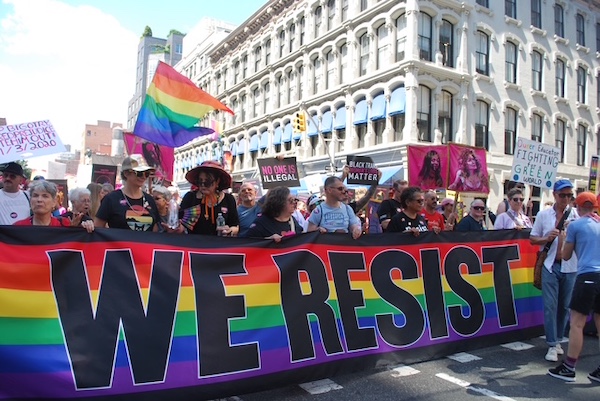
The parade was self-marshalled, with the NYPD posted at barricades a block
away. They added a Health Fair in 2021, in partnership with Treatment Action
Group, testing for Covid, HIV, and Mpox, “with sex workers, trans, and gay men
working together to get rid of it.”
Marchers mingled together rather than in contingents, carrying whatever
banners they chose. Walker saw the QLM as “the one day we can actually be a
community. Regardless of how you identify, you are in this marvelous sea of
diversity where you can make connections. It was something empowering and
helpful to people who want to continue that resistance.”
Walker believes the commodification of queer identity and the pinkwashing of
our community has been problematic for years before Donald Trump got into
office. This undercurrent of anger and resentment fomented after Pride
celebrations that felt like “a performative thing for straight people to come look
at the gays.”
The community led QLM showed that marchers could navigate the New York
City landscape safely without the NYPD in their midst, that the community could
emerge from the event empowered, and that they could do it with minimum
funds being used only for accessibility items like wheelchairs and ASL interpreters.
“With this shift, people understand that we have been relying on corporations
who were also donating money to anti-gay and anti-Black politicians all along,”
said Walker. “You can see now that they will turn on you when the tide shifts. All
they care about is their bottom line and a package of favorable laws from DC.”
This year, said Walker, the QLM is intentionally seeking to capture the
corporate-free vibe of the original Christopher Street Liberation Day march.
They will begin at 11am at the AIDS Memorial at St. Vincent’s Park on Seventh
Avenue, cut up Greenwich Avenue to Eighth Avenue and march to
Columbus/Lenape Circle at Central Park. The march will pause midway at the
steps of Penn Station/Moynihan Station for marchers to join in.
Their theme is Resist! Reclaim! Rejoice!, which Walker said means, “resist now
to reclaim our rights and in the end we will rejoice.” There is no registration
necessary; just show up. Those who want to volunteer can follow the link on
QLM’s Instagram to access organizer forms.
Politics Pollutes Protest March
No registration is ever needed for the NYC Dyke March. For more than three
decades, it has been a street protest, loosely organized and wholly unpermitted.
Marchers just show up at Bryant Park on the Saturday of Pride weekend, (June
28 this year), step into the streets at 5pm, and march down Fifth Avenue to
Washington Square Park.
Fundraising is limited to bar events and donations from marchers, which the
Committee uses to cover the basic costs of accessibility via wheelchairs, masks,
mobility devices, and ASL interpreters.
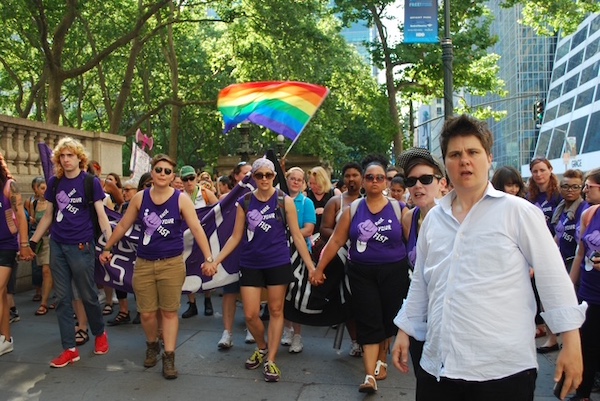
“The advantage is that we are not beholden to any corporation’s funding to make
this happen. We don’t have that massive infrastructure to fund, but the
disadvantage is that things can be unpredictable,” said NYC Dyke March
Committee Member Alice Siregar.
NYC Dyke March Committee Member Beans echoed this sentiment, saying, “in
our super-fascist Trump 2.0 America, anyone who supports us gets their funding
cut. I think this is a case in point proving the ethos of marches remaining non-
corporate. In the end, they will abandon us.”
“Where Pride became more of a parade, throughout the years the Dyke March
has remained a protest march with signs and slogans, very guerilla style,” said
Siregar. Formerly a local New York marcher, this year the Montreal dual citizen
has not been able to cross back into the United States, saying they confiscated
her birth certificate. Instead, she is working to organize Dyke March Montreal,
which had been on hiatus for almost a decade.
“Come in solidarity, protest, resistance, anger, fury and joy,” said Siregar. “All
are welcome, because now more than ever it is important to be visible. Going
into the streets alone to protest can be daunting. But marching with a
community of 20,000 brings resilience and safety in numbers.”
The theme of this year’s event is Dykes Against Fascism. Dyke March
Committee Member Beans noted that, “Twenty-plus years ago, the theme was
also Dykes Against Fascism, so it shows there is an imperative to keep this
going.”
Not everyone is thrilled about this year’s NYC Dyke March. While it has always
been volunteer-run and non-hierarchically organized, Wolfe said beginning last
year, organizers alienated a group of Jewish lesbians over what she called a “very
anti-Israel statement about the war in Gaza, with no mention about the October
7th attacks or anti-Semitism.” Wolfe said last year’s NYC Dyke March eventually
went forward with a banner reading, Dykes Against Genocide.
“But who would be for genocide,” asked Wolfe. “Plus, they didn’t mention
Sudan, Rwanda, or any other places under authoritarian rule with large number
of the population being decimated. You can’t single out one—and anyone who
objected was dismissed.”
Last year in San Francisco and Chicago, similar unrest prompted organizers to
forbid marchers with Israeli flags. Wolfe said NYC organizers tried to ban all
national flags, “But the whole point of Dyke March is to make it inclusive and
welcoming to all people.” She didn’t march last year and will decide at the last
minute whether to participate this year.

“People should know the Dyke March belongs to the community, and not to any
specific group of people. It’s not a political party,” said Wolfe.
With DC politics roiling our good time, organizers of Pride celebrations reliant
on corporate giving are trying to fill in the blanks. “As we see this decrease in
corporate support, we are trying to shift to individual and peer-to-peer giving,”
said HOP’s Cheng. “We have asked our community to step up and help us.”
Walker said the QLM will sidestep corporate funding to access the
intersectionality of queer identities, “one of the most powerful forces there is.
Queer people comprise every part of life on this planet, and right now trans and
nonbinary people are the canary in the coal mine for the human rights struggle.
We will address all of this at the QLM, and we welcome all people fighting to be
free from genocide in the Congo, Palestine, Hungary, plus transfolks in Great
Britian. We are all part of this large human struggle, and that’s what QLM is all about.”
In the ebb and flow of the fight for LGBTQ+ rights, “You can’t always march
forward; sometimes you have to take a few steps back,” acknowledged Evans.
“Pride sponsorship isn’t just a party; it’s about equal rights. We gave away a lot
to corporate sponsors, from parties to cheaper rates, and it ruined our business
model. We are not giving anything else away. If you’re a sponsor, isn’t ‘thank
you’ enough? It takes a little courage, but the whole country needs heroes.”
As the thugs in DC try to steal our joy, just remember that the gay community
has faced worse than Trump, and still managed to grow and thrive. We will
endure.
Read more
 Winnie McCroy